|
| |
Marriage between persons of different religions
French
version
mariage et religion - mariage entre personnes de religions différentes
|
or
interfaith marriage or mixed marriage.
First,
we must say that mixed marriages only work successfully if both people agree on
and demonstrate mutual respect for the other's religion long before they are
married, and continue to do so afterward.
As for kids-- and I'm sure this will be an unpopular viewpoint-- I believe in
keeping religion out of children's lives until they are ready to ask questions
and make decisions for themselves. I'm specifically referring to attending
services, learning about the teachings and beliefs of the two religions.
Note that a civil marriage,
in countries where it exists, is possible between persons of different religions and him even desirable if there are
children...
The conditions below concern only those who want, besides, to make celebrate their marriage in the religion of one of the fiancés.
Marriage
of a catholic with an orthodox or protestant.
For an exemption
granted by the bishop's palace, these persons can get married to the Roman Catholic Church, or in a church of the other
cult. In that case, a catholic priest can participate in the rite, but it is not compulsory. It is not allowed to organize two ceremonies in each
confession, because it would mean exchanging twice the assent
See
http://www.newadvent.org/cathen/09698a.htm
Go
top
|
|
Marriage
of a catholic with a non-baptized person.
The parish has to ask the bishop's palace an "exemption of disparity of
cult ". The not-baptized person has to express its agreement with the essential elements of the Christian marriage (freedom, fidelity, indissolubility and opening in the fertility). The catholic person
must do all what depends on their to
insure the baptism and the catholic education of their children. The future not baptized spouse is informed about the commitment of the Christian
part and about the sense of the marriage in the Christianity. The marriage can indeed, with
exemption, be celebrated in front of the Church. It is a marriage "dispar" (or mixed). The catholic spouse who seeks an exemption of disparity of
cult so shows that she intends to remain faithful to the Christian faith, including to
this mixed
marriage; the priest who receives it, has to feel that his faith is firm and
lit, the Church measures the risk for the faith of the Christian which wants to make a
commitment and acts with caution. The exemption can be
refused.
http://www.newadvent.org/cathen/09698a.htm
catholicmatch.com/articles/details.html?article_id=831
2-in-2-1.co.uk/forums/showthread.php?p=20965
In the case of a Protestant, the marriage is possible
between a Christian and a Muslim. Because of the important sociocultural differences, we advise to discuss in advance the essential points of the life of
the couple, because these differences can be
source of conflicts and difficulties which would be an obstacle to a durable
happiness. In many parishes, there is a minister specialist of the inter-religious questions which you can
consult.
incore.ulst.ac.uk/services/cds/themes/marriages.html
Go
top
|
|
At the Catholics, with an exemption of "disparity of
cult", the marriage is possible. If such a marriage is decided, it can takes place somewhere else
than in a church, not so as to strike the Jewish family by Christian symbols as the cross.
However, the Jewish religion opposes to any mixed
marriage. And it does not thus accept a marriage of oecumenical type celebrated collectively by a priest and a rabbi.
Here is the website of a britannic rabbi who lives in London and travels
every where in Europe. He practises of oecumenical ceremonies for marriages with
priests or ministers.
http://www.rabbi.eu.com/page10/page10.html
Other useful sites for jewish
jewishjournal.com/home/preview.php?id=12195
http://www.newadvent.org/cathen/09698a.htm
|
|
1
- If the "fiancés" want to marry in christian church they need to have an exemption of
"disparity of
cult ". The marriage is possible in a catholic church between Catholics and
Muslims. It is advised to consult a priest or a minister on the problems which the islamo-Christian
marriage can
raise, for the couple.
2
- If the fiancés want to marry in islamic rite, they must know that the
traditionnal Islam allows a Muslim
man to marry a Christian
woman, through Islam ceremony, but refuses that a Muslem woman marries a Christian.
So the Christian fiancé must convert to Islam faith.
http://www.soundvision.com/Info/marriage/
That is corrected by some recent fatwa
exposed here :
|
|
(Note: This defense uses the example of
a Muslim woman marrying a Christian man, but the principles apply to marrying
any non-Muslim man.)
"The verse that is traditionally
used by imams to prohibit an inter-religious marriage is Qur'an 5:5, which
states: 'This day, all innately good things are lawful for you... Lawful to you
are the chaste women from among those who have been given the Book before you...'
Traditional imams contend that since women are mentioned, and men are not, then
it must be understood that the marriage of Muslim women with non-Muslim men is
forbidden.
This, however, is problematic. For the
Qur'an is addressed, because of the custom of the time, to men. It is for
this reason that the Qur'an says, for example, "And when you divorce your
wives..." or "During the nights of fasting [Ramadan] you may have sex
with your wives..." What do I mean by the custom of the time? In the tribal
context, the woman, once married, accepted the husband as master. He, in
turn, accepted the religion of his tribal chief.
Given that reality, a whole host of
issues arose for Muslim scholars -- issues that made them oppose inter-religious
marriages for women. One issue was, whereas Muslims honor the non-Muslim
prophets, followers of the other two monotheistic religions do not honor
Muhammad, and that would put the Muslim woman in the terrible position of having
her prophet disrespected. Another issue was that most Christians see Jesus as
God, and for a Muslim to attribute divinity to a human in unthinkable. Then, too,
there was the problem of the children from such a marriage, who would presumably
be brought up in the religion of the male spouse.
But remember that all of these 'issues'
assume the woman must take the faith of her non-Muslim husband, and that is
clearly not the case in your relationship. You live in a different time and a
different place.
To be sure, most Muslims would argue
that the Qur'an is true for all time and all places. If we go by that logic,
then we must acknowledge that the Qur'an is still sympathetic to your
dream of marrying a Christian man. Even though he is a Christian, the Qur'an
does not hold that against him. For while mentioning that there are Christians
who take Jesus as God, Islam's main document calls this 'kufr' (disbelief/ingratitude)
rather than 'shirk' (polytheism). It's a significant distinction because, in
another verse, the Qur'an also states that Christians who do good deeds have the
right to enter heaven. Christian creedal beliefs are the same for both male and
female followers of Christianity, so how can the Qur'an allow marriage to the
Christian woman but not to the Christian man?
The evidence indicates that the main
hang-up is the problem I emphasized above -- that the religion of the male
spouse becomes dominant (as also evidenced in the Book of Ruth in the Hebrew
Bible). In our day, since Qur'anic Islam (as opposed to the Islam of the male
jurists) must acknowledge the radical notion that women are equals of men, that
women have legal rights, and that those rights include placing conditions on the
marriage (what you and I would term a 'pre-nuptial agreement'), then an
inter-faith marriage can take place on condition that neither spouse will be
forcibly converted to the other's religion. As long as that condition is
respected, you and she have my blessing.
On the question of children, certainly
there will be some religious confusion. But as a Muslim scholar, I can tell you
that the Qur'an advocates the use of the heart and mind in forming opinions. If
both parents are faithful to their interpretations of the Creator's will, then
the children will make informed decisions when they come of age.
Dr. Khaleel Mohammed studied Sharia at
Muhammad bin Saud University in Riyadh (Sunni) and the Zeinabiyya in Damascus (Shia).
He holds a Ph.D. in Islamic law from McGill University.
http://forpeoplewhothink.org/Answers/Interfaith-Marriage-FAQs.html
You may reach me through
www.forpeoplewhothink.org.”
Go top
|
|
A
Turabi Fatwa about muslim women can marry Christian or
Jew...
In
www.sudantribune.com/article.php3?id_article=15021
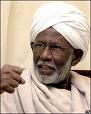 "Turabi described
the teachings that a Muslim woman should not marry a Christian or Jew as
misguided teachings intended to confuse and keep women behind. He explained that
the practice has its origins in war times which were used against those fighting
with Muslims, but which ceased once hostilities were over." "Turabi described
the teachings that a Muslim woman should not marry a Christian or Jew as
misguided teachings intended to confuse and keep women behind. He explained that
the practice has its origins in war times which were used against those fighting
with Muslims, but which ceased once hostilities were over."
After
that, in this
article, a lot of advices about women right...
http://en.wikipedia.org/wiki/Hasan_al-Turabi
http://www.nuitdorient.com/n3228.htm
24/04/2006
London, Asharq
Al-Awsat- The following is the full text of the controversial interview that
Asharq al-Awsat conducted with Sudanese Islamist leader Dr. Hassan Turabi, which
resulted in him being branded an apostate by Sudan's
Muslim scholars:
Q) Fatwas that you have issued,
regarding the permissibility of marriage between a Muslim woman and a man of the
Christian or Jewish persuasion, have been the subject of much controversy. Do
you mean that married women who converted to Islam can remain married to a
non-Muslim husband, or that a Muslim woman can marry a non-Muslim man?
A) First, we have to look at the context
of this matter particularly from the framework of Ijtihad when it comes to the
general issues of women in Islam. The modern and contemporary Islamic discourse
on women lags far behind the authentic Islamic rules and principles as
contemporary Muslims do not think deeply about these principles when it comes to
the marriage of their daughters.
The fatwa was a response to issues in
the Muslim community in the United States. There was an incident in which an
American woman went to one of the Islamic centers to convert; however, she
wanted to remain married to her non-Muslim husband after she converted. The
center's officials told her that if she was sincere in her desire to become a
Muslim that she would begin divorce procedures, despite the huge costs and even
if this meant that she would lose custody of her children. They did not consider
that this was too much to ask from someone who was still taking their first
steps towards Islam. Such an attitude in fact causes many women to be reluctant
to convert.
Of course, before issuing the edict, I
had to undertake a lot of research concerning Islamic law, particularly by
reading books on Islamic jurisprudence that were written at certain historical
intervals. All the past fatwas that prohibited the marriage of Muslim women to
non-Muslim men were issued during periods in which political disputes between
Muslims and non-Muslims were taking place. On the other hand, I could not find a
single word that prohibited such marriage in either the Quran or the Sunnah.
In the particular case of the woman who
wanted to convert in the United States, my opinion was that she should have
remained married to the non-Muslim man. She may have been the reason that her
non-Muslim husband converted. Perhaps even other families of female American
converts would have followed the same path. Many people were perplexed by what I
said and attacked me for it. Some even decided that I was now an infidel! They
depicted the whole issue as if it was a matter of honor. However, if you look at
it objectively, the conversion and Islamic conduct of the wife may have
positively influenced the husband, an influence that the Muslims of the West
need.
We should let the Muslim minorities, who
live amongst the 'People of the Book' in the west, evaluate this issue and
decide what is appropriate for them, as they are the first group affected. They
would conclude that they should allow their daughters to marry Jews and
Christians because perhaps these marriages will bring the husbands to Islam or
else the women may remain a Muslim. In the West, the individual freedoms are
generally wider and the Western Muslims to decide when it comes to this issue
especially.
Q) So are you saying that women who
converted to Islam can remain married to their non-Muslim husbands, but that a
Muslim woman marrying a non-Muslim man is forbidden?
A) No, I had spoken previously about
this type of marriage and I believe that marriage between a Muslim woman and a
non-Muslim man is valid since nothing in the Quran or Sunnah dictates otherwise.
The decision should also be based on the individuality of each case therefore; I
cannot say this type of marriage is prohibited based on the accumulated
teachings of past scholars.
These teachings for example tell us that
Ijmaa (consensus) is the consensus of jurists at any given age but the Quran
says is different. The same accumulated sayings of scholars also recommended
that we should obey the ruler even if he seized power by force. The Quran does
not approve of this. We should always refer to the origins that are Quran and
Sunnah....
( http://www.asharq-e.com/news.asp?section=3&id=4678
)
See
also : forpeoplewhothink.org/Answers/Interfaith-Marriage-FAQs.html
and
:
www.newadvent.org/cathen/09698a.htm
2-in-2-1.co.uk/forums/showthread.php?t=2695
http://www.forpeoplewhothink.org/.../Interfaith-Marriage...ml
Go
top
|
|
How to convert
http://www.islamreligion.com/articles/204/
Go
top
|
|
Other
religions
|
Search
on Google :
names
of the two religions + marriage
|
"...
The Code of the family voted in 1984 in the Algerian National Assembly
is for me one of the factors which made possible the lynching of the women of Hassi Messaoud.
It governs the personal status of the woman within the couple, making of her a minor for life, passing of the
supervision of the father in that of the husband, in front of obedience to this last one, and being able to be rejected at any time, the husband having the
right to keep the conjugal accommodation while the woman meets outside with her children. And even if this code knew light amendments, in 2005,
it remains profoundly unegalitarian and criminal. By weakening the women and their children, it is the quite whole
society which it weakened. Furthermore, by giving the women and under the control of the
men, this code sends a strong message to all the society and to the men in particular: " If you have problems, ill-being, do not break us the head with your demands, let off stream on the women! "" As says the Algerian proverb: " Tekber or tansa wou ttaffrha fi' not
her ", "you will increase, you will forget and you will charge him to the
women."
" The second important
factor is the large-scale work of the fundamentalists who, during years, soaked all the social fabric of their profoundly resentful and misogynous speeches, by
appointing the women as the cause of all the troubles of the society. They
hijacked the religious texts so as to strengthen the ascendancy of the men. During the years of triumphant terrorism, in the threat of the women who did not submit themselves, was added the
removal of several thousands of them in resistance movements by the fundamentalist armed groups.
They were violated, tortured there, subjected to the slavery. Many of them were murdered or disappeared in the nature. Their executioners were little worried, even in no way. Today, we call them penitents without that they regret of nothing and they move in cities with complete impunity.
" Everywhere in Algeria, humbled women do not manage to assert their rights for the
safety nevertheless registered in the Constitution...
Nadia Kaci (
extract)
|
Complement
by Sheri & Bob Stritof
| |
|